

Welcome to another edition of Company Spotlight! This article will focus on Workhorse Group Inc., or “Workhorse” (WKHS) for short.
You may be familiar with Workhorse from its primary business line: Electric Vehicles. Specifically, electric trucks. Why then would I include the company in the DRONES Index and devote an entire article for a Company Spotlight article on a Drone-focused blog? Because Workhorse is also a UAV manufacturer. Moreover, I think they have an interesting operational concept that could become very valuable in the next five years—more on that later.
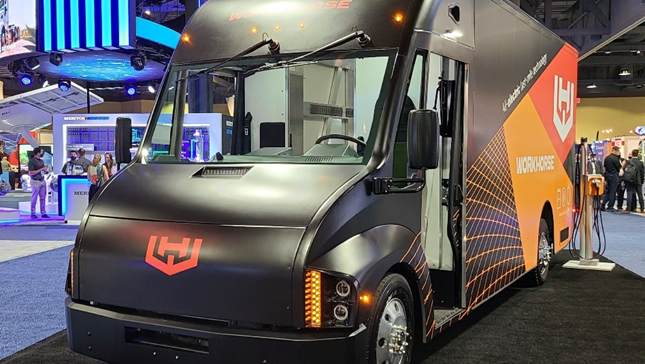
Workhorse was founded in 2007 as AMP Electric Vehicles near Cincinnati, OH. It later merged with a spinoff from fellow EV company Navistar and renamed to Workhorse Group Inc. in 2015. It formed a partnership with its crosstown cousin, Lordstown Motors, for production of the W-15 pickup truck, which was later rebranded as the Lordstown Endurance pickup truck. Workhorse’s primary product line became Class 4-6 trucks, the same vehicle class used by delivery companies such as UPS and FedEx.
Workhorse has had its share of corporate drama and investor mood swings. It became entangled in investor fraud lawsuits following a failed bid at a U.S. Postal Service (USPS) solicitation for its Next Generation Delivery Vehicle (NGDV). Workhorse survived the initial testing and down-selection to the final three candidates, but ultimately lost the competitive contract to Oshkosh Defense. Workhorse filed a formal protest against the selection process which was eventually withdrawn. The basis of the investor fraud suit involved company actions that may have overstated its competitiveness for the USPS contract, and insider selling prior to public release of its non-selection status.
Workhorse underwent some internal restructuring and refocus on developing high-quality EV trucks and bringing them to the commercial market. During the first half of 2023, Workhorse established certified dealership partnerships in California and Georgia. Its three current EV products are the W4 CC, W750, and W56 Class 4-6 vehicles. These vehicle classes support the Less-Than-Truckload (LTL) subset of the General Freight Trucking industry; LTL is an estimated $230 billion industry in the U.S. alone, and is projected to experience a Compound Annual Growth Rate (CAGR) of 8% for the next four years.
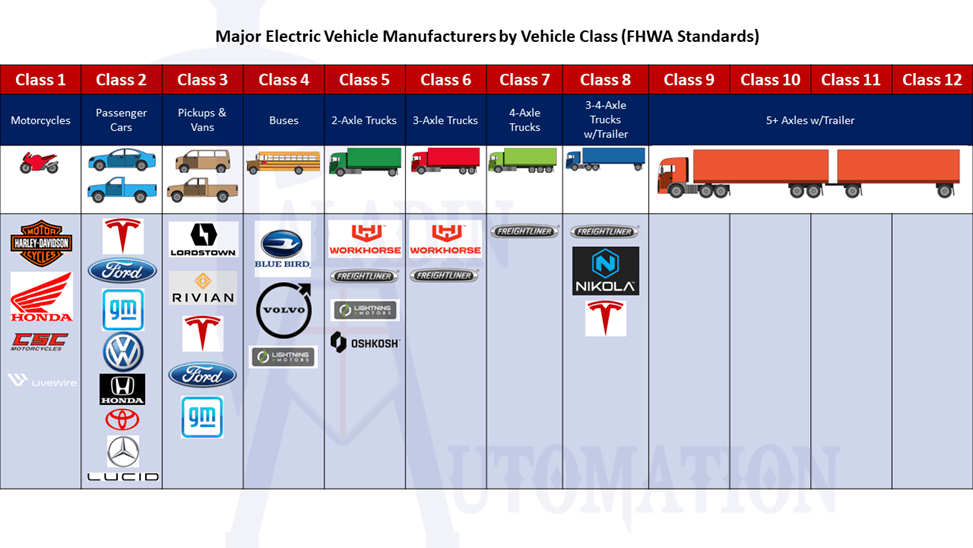
To better understand where Workhorse fits into the cluttered EV landscape, this graphic helps pinpoint their niche. This is not intended to be an exhaustive list of all global EV manufacturers, but it should give some insight into its primary market and main competitors.
Enough about Workhorse the EV company—I am here to write about Workhorse the drone company.
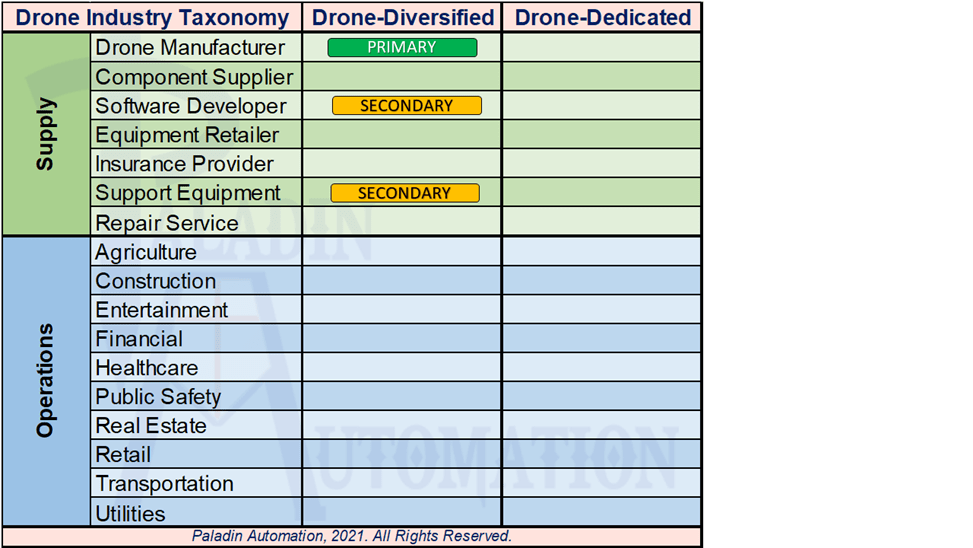
Drones are a sideshow for Workhorse, so I categorize the company as Drone-Diversified. Here is how I identify it in my taxonomy of the Drone Industry.
I was originally uncertain if Workhorse developed and produced its own drones, or if it merely had a production/rebranding arrangement with a drone manufacturer. Once I started receiving notifications of job openings for Drone Pilots and Drone Engineers in one of my job feeds, I realized that they were doing the work in-house. The Workhorse Aero division has a dedicated Aerospace Facility in Mason, OH.
Through the Workhorse Aero division, the company currently manufactures two delivery drone models: the WA4-100 HorseFly, and the WA4-200 Falcon.
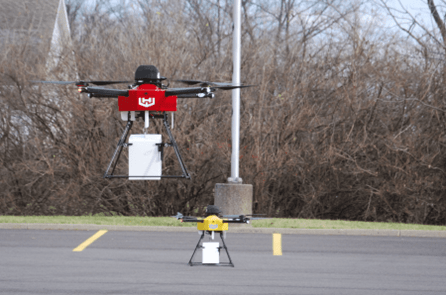
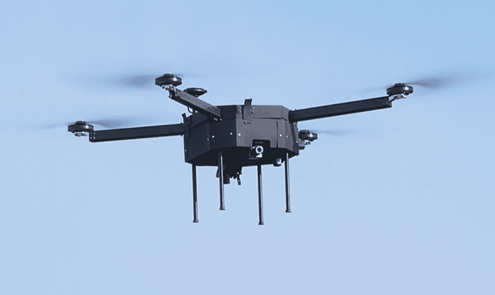
The HorseFly is envisioned to be the primary aerial delivery vehicle for commercial usage, while the Falcon appears to be a lightweight ruggedized version intended for military and law enforcement operations. The drones feature a 10-pound payload capacity with winch or servo options for payload drop, and fully autonomous flight modes. The payload limit encompasses about 80% of residential and commercial package deliveries. Workhorse received its first commercial drone order in June 2023 from Valqari, a U.S.-based company developing smart mailboxes.
There are dozens of Drone Delivery solutions on the market—what makes the Workhorse products different? This is where I am intrigued. Workhorse is one of two commercial entities that I am aware of that have patented intellectual property for drone integration with a vehicle (the other is Ford). The company has not openly discussed the operating concept in any public form that I am aware of, so I will make some conjecture.
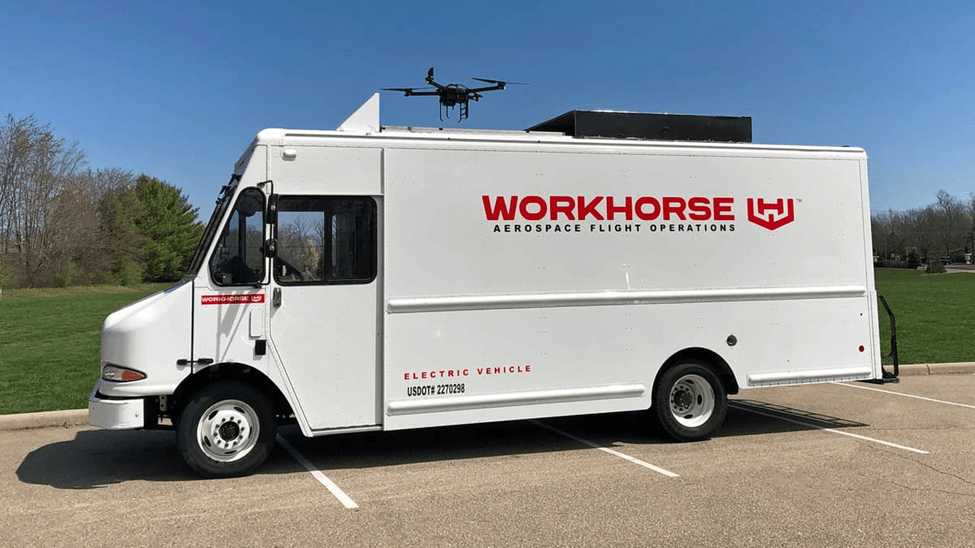
The “last-mile drone delivery” concept is in its initial commercial demonstration phases at Wal-Mart and Amazon Prime Air. Those companies are launching drones from the store/warehouse rooftop out to about a 5-mile radius. Both companies’ efforts appear to be at a stagnation point: flight beyond 5 miles is challenging for both technical and regulatory reasons.
- Technical Obstacles
- Multicopter drones can typically carry somewhere between 10-50% of the airframe empty weight as payload (HorseFly carries 16-30%, depending on configuration). Longer flight distances require either a lighter load, or bigger batteries (which still often forces a lighter load). The only way to extend both the range and payload carriage is to make the drone so big that it is no longer safe to fly in confined areas such as residential neighborhoods and building complexes.
- Required safety features in certain operating conditions (propellor shrouds, parachute, lights, etc.) add weight and power penalties to a system that is already near its maximum capacity.
- Regulatory Obstacles
- The FAA has placed a threshold of 55-pounds on a drone (with cargo) to operate under commercial Part 107 rules. Drones larger than 55 pounds are subject to a different set of rules, which makes the operation less cost-efficient.
- The FAA requires the Pilot-In-Command (PIC) to maintain Visual Line Of Sight with the drone throughout its flight (this is waivable under certain conditions). Drones of this size class are not expected to be visible beyond 2-3 miles under most conditions, and the PIC will almost certainly lose sight if the drone lands behind buildings or trees.
- The FAA has certain requirements for operating a drone over people. These include shrouding the propellors and minimizing the impact energy of a crash (often via parachute).
- A Part 135 Air Carrier certification is the official requirement to carry cargo for commercial purposes. This imposes administrative overhead costs that decrease the efficiency of the operation.
Wow, this is depressing. It comes as no great surprise that our leading retailers are experiencing difficulty in the introduction of this new operating concept.
This is why the Workhorse solution intrigues me.
There is good reason that the drone’s origin and destination should be within 5 miles of one another. I think this is why Wal-Mart’s drone delivery program is enjoying greater success than Amazon Prime Air’s program: there are simply more Wal-Mart stores than Amazon Fulfillment Centers to use as launch points, and they are closer to the customers.
Workhorse is taking a different approach: it is putting the launch point on wheels.
Delivery vehicles tend to batch their deliveries into routes by sectoring up a geographic area. Each route will inevitably include some concentrated population centers with multiple stops: a residential neighborhood, an apartment complex, an industrial park, a college campus, etc. My theory is that Workhorse’s operating concept is to equip a truck with 3-5 HorseFly drones, drive the truck to a preplanned “distribution point” in the vicinity of each population center, and employ the drones to simultaneously conduct the last-mile deliveries to individual endpoints. Currently, delivering 5 packages within a residential neighborhood could consume 20-30 minutes; Workhorse’s solution could potentially complete the same operation in as little as 4-6 minutes by parallelizing the last-mile function with an airborne solution.
While there are still numerous technical and regulatory obstacles to this operating concept, I believe it will eclipse “traditional drone delivery”—that is, originating from a rooftop or parking lot—within the next 5 years.
So far, we have briefly discussed Workhorse’s history and future potential. Let’s take a look at WKHS through the lens of a retail investor.
Within the DRONES Index, I categorize WKHS in the Speculative Portfolio. There is potential for this company to become a multi-bagger, but it is based on hope. If the company becomes profitable, I will move it into the Growth Portfolio.
Workhorse is categorized in the Consumer Discretionary sector, Auto Manufacturers industry. The sector tends to have cyclical patterns that mirror consumer spending. Today’s high-interest environment is especially challenging for early-stage companies that require debt to fund continued operations before breaking the Profitability barrier.
The WKHS share price has fluctuated wildly based on hype, rumor, and a brief stint as a meme stock. Here is its 3-year history, compared with industry benchmarks CARZ (Future Vehicles & Technology ETF) and VCAR (RoboCar Disruption and Tech ETF). I feel that these are the most appropriate comparisons for a company that is 98% Electric Vehicles, and 2% Drones.
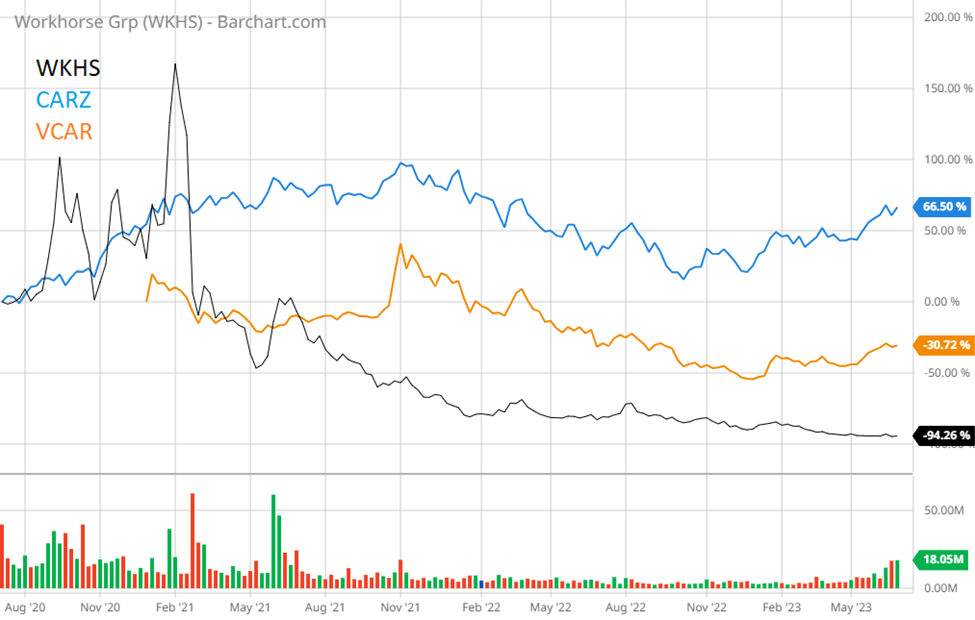
You can see the activity in 2020 and 2021, during the USPS NGDV competition. The spike in June 2021 is during its stint as a meme stock. Other than those outlier events, the WKHS share price has steadily declined in the last 3 years, while the benchmark indices have fared slightly better.
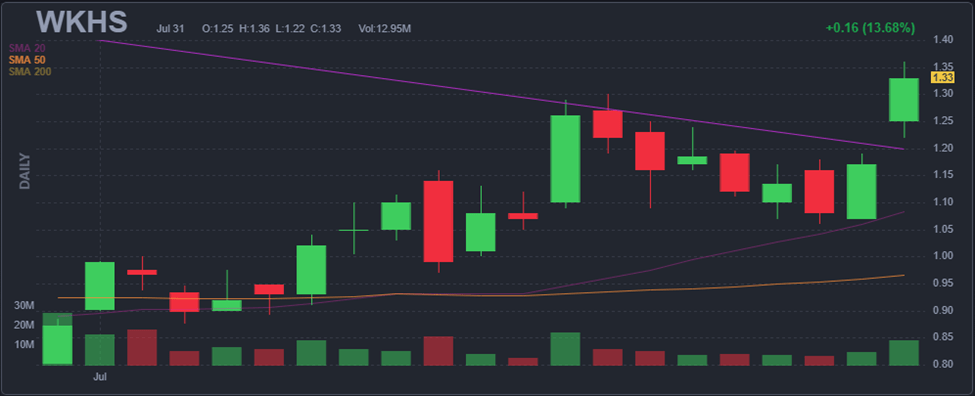
Let us zoom in on the last month of the stock’s performance (as of late July 2023). The share price has broken the resistance level, and the 20-Day Simple Moving Average (SMA-20) recently crossed the SMA-50. It still has some ways to go before crossing SMA-200, but these may be early indicators of bullish activity.
Next, let’s take a look at its valuation.
| WKHS | Consumer Discretionary Sector | |
| P/E Ratio | N/A | 32.56 |
| EPS | -$0.70 | $8.35 |
| P/S Ratio | 28.35 | — |
| PEG Ratio | N/A | — |
| Price/Book Ratio | 2.35 | — |
| Return on Equity | -92.12% | 106.19% |
| Analyst Recommendations | Weak Buy | — |
| Analyst Price Targets | $2.58 | — |
| Implied Change | +94% | — |
These numbers are not pretty. In fact, they are pretty ugly. The WKHS fundamentals as reported on their most recent Earnings Report are not much better. Workhorse is currently debt-free, which is a great benefit in our high-interest environment. However, they only reported $79 million cash balance, and have reported net losses of $129 million to $185 million in each of the last two years. Here is how 2022 looked, as reported on the company’s Income Statement.
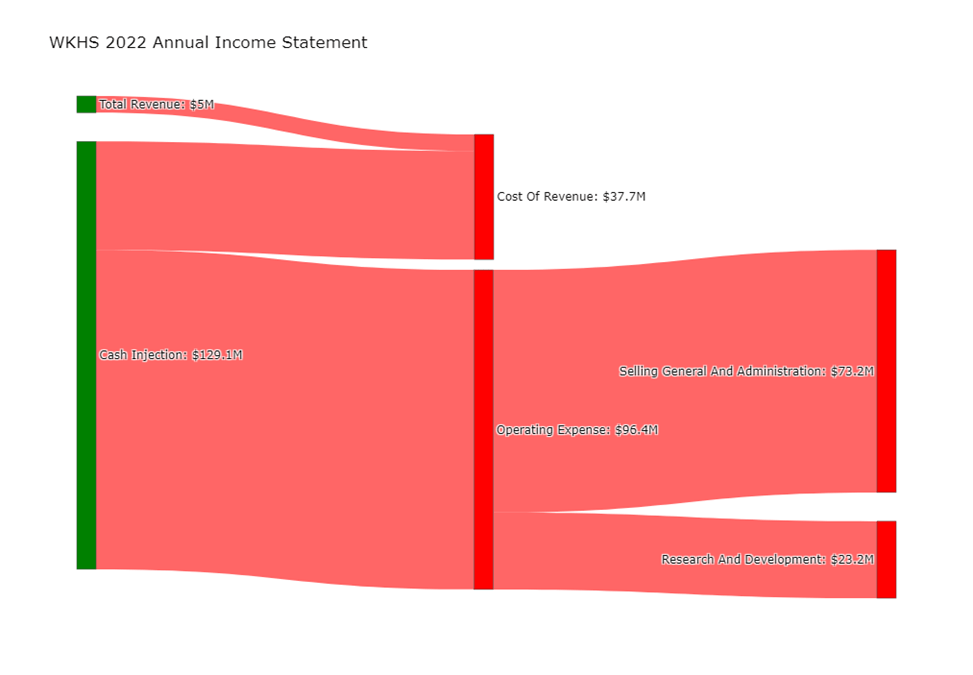
The company seems to have a lot of momentum, but not much fuel in the tank (so to speak) to back it up. The company’s tenuous cash position makes the latter half of 2023 a make-or-break period, which may be why they are redoubling efforts to establish dealer partnerships and win government contracts. Workhorse recently announced an upcoming Special Shareholder Meeting to vote on increasing the number of authorized shares—essentially raising more capital but diluting the value to current shareholders. The value of the proposed sale has not yet been publicized. (August 3 Update: the number of shares is proposed to increase from 325M to 525M, a 61% increase.)
Going forward, I see several tailwinds in Workhorse’s favor:
- The California Advanced Clean Truck (ACT) Rule mandates that automotive manufacturers increase the percentage of zero-emission truck sales from 2024-2035. This rule is gaining traction in 14 states.
- Workhorse is in the process of establishing dealer partnerships in 22 states.
- The most recent Shareholder Presentation alludes to several government and commercial sales contracts in some level of progress.
Is WKHS a Buy? It is nestled in the middle of two growth industries (EV’s and Drones), so I generally say Yes. Workhorse has immense potential, and the upside is greater than the downside. Like so many other companies in these two industries, its revenue has not quite caught up with its investments in Research and Development.
If you do choose to Buy WKHS, here are two paths I will offer:
- Buy shares today, and sell at 10% profit or August 27, 2023, whichever comes first (August 28 is the Special Shareholder Meeting that will likely result in selling additional equity, thus diluting share value).
- Buy shares the day after the new shares become available for purchase. Share value will likely be discounted some 20-50% from pre-sale value.
After we get through the inevitable volatility this fall, I would expect to see WKHS follow a slow but steady trajectory in the positive direction as the company gains market traction and the FAA relaxes prohibitive regulations. It will be a bumpy ride, but pioneering is never easy. I see Workhorse (WKHS) as a good investment opportunity for risk-tolerant investors that believe in the future of the EV and Drone industries, and the share price is hard to beat.
As always, please conduct your own research and consult a Financial Advisor for any potential investments. The author holds a long position on WKHS.

 Paladin Automation LLC
Leave a comment