
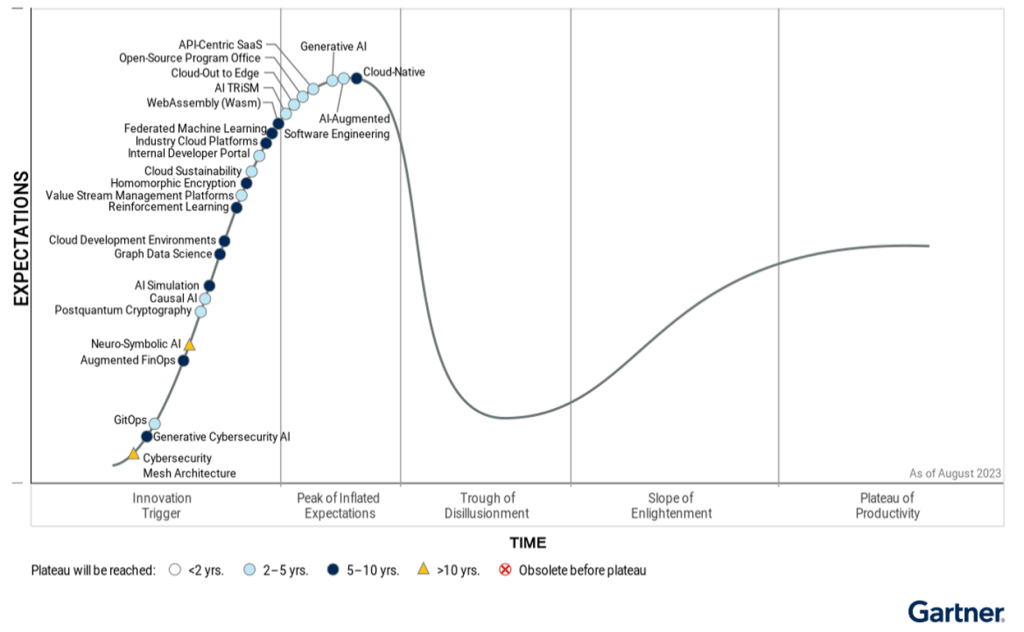
Two years ago, I wrote a piece that followed the last several years’ worth of Gartner Hype Cycle trends and linked them to the Drone Industry. Today, I update those findings with the 2022 and 2023 reports.
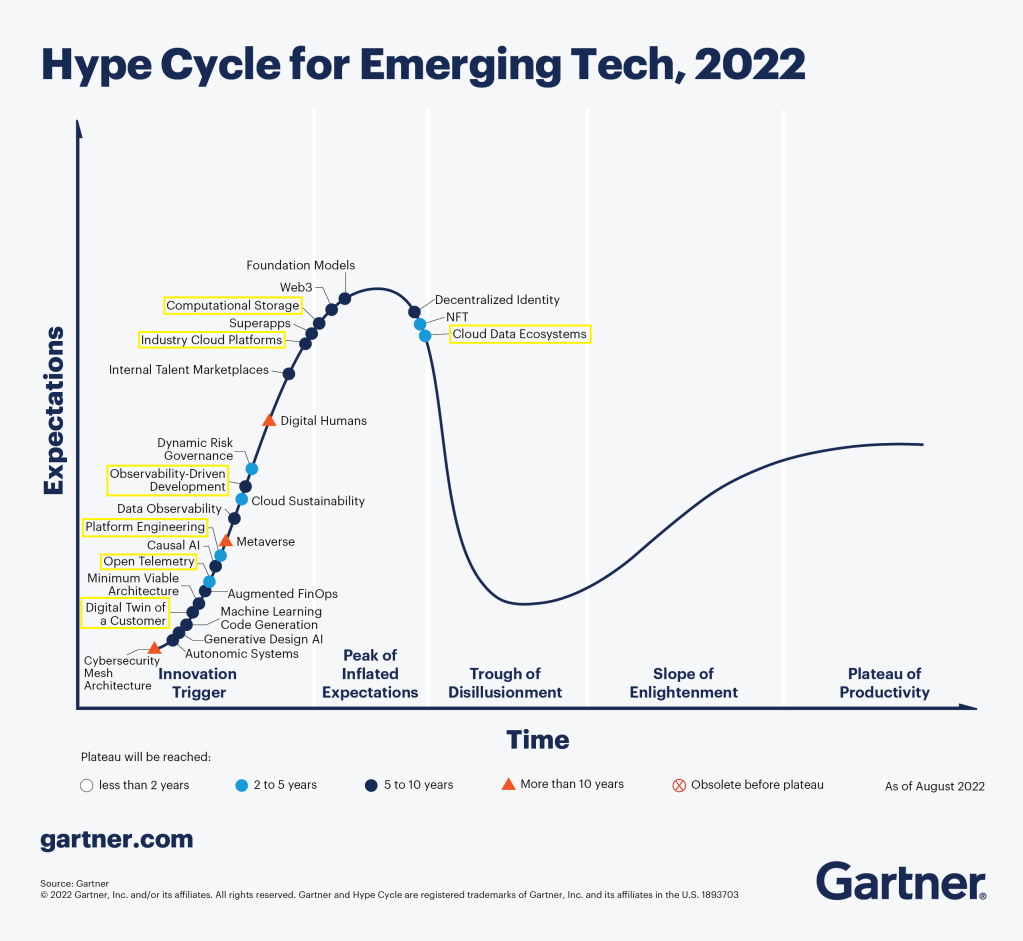
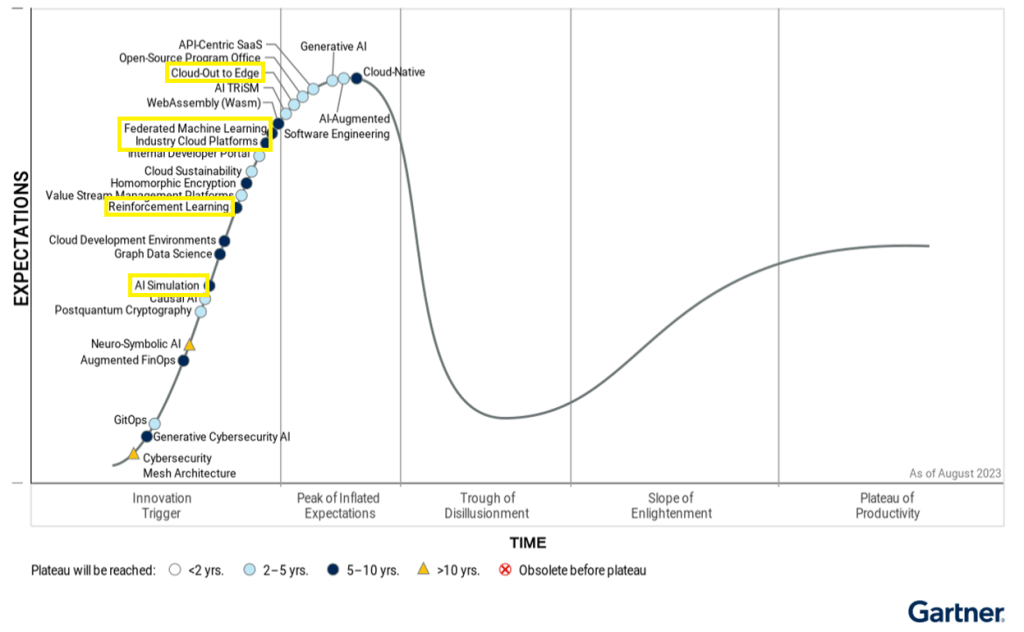
As before, I took the liberty of highlighting technology areas that relate somehow to the Drone Industry. Also as before, I am somewhat disappointed that Gartner chose not to track technology trends beyond the Peak of Inflated Expectations.
There are two general technology trends that I have observed going through various permutations over the years: Big Data and Artificial Intelligence (AI).
Big Data
The term “Big Data” has become somewhat archaic and is being superseded by emerging concepts such as “Cloud” and “Internet-of-Things”. In general terms, Big Data is the concept that humanity now has the ability to collect and generate information faster than our ability to transport, store, process, and exploit it. (As an amateur Data Scientist, my definition of Big Data is “Data that is too big to work with in Excel”.) Hence, there are petabytes of information generated every second that simply vanish into the ether, unharvested and unused.
As an example, let’s consider a standard smartphone. Most modern phones contain the following sensors:
- Microphone
- Optical Camera
- Touchscreen
- 3-axis Accelerometers
- 3-axis Gyroscopes
- Magnetometer
- GNSS Receiver
Some phones have even more sophisticated sensors, such as Radar and LIDAR. These sensors can be combined or repurposed in some creative ways: your phone’s Magnetometer can act as a compass, and can also serve as a low-grade metal detector.
Most of these sensors measure data at sampling rates greater than 10 Hz (greater than 10 times per second), but the data is only stored if there is an app or some other active process recording it. With a generous estimate that 5% of your phone sensors’ measurements are utilized for some purpose, that’s roughly 9 million daily measurements that are completely unused, by a single device. Across the globe, this equates to roughly 6.1 x 10¹⁶ daily measurements that vanish without purpose! If even a fraction of global smartphone accelerometers could be monitored in real-time, imagine what that would mean for our ability to measure seismic activity in the earth’s crust.
Why do I link Big Data to Drones? Because a drone is a flying bundle of sensors: GNSS, Magnetometer, Accelerometer, Gyroscope, Barometer, Air Temperature sensors are common in most modern flight controllers. Drones are low-quality Weather Balloons, employed in mass around the world. In addition, the drone payload is often some form of a sensor–optical imagery is the most common.
Drones provide a cost-effective technique to employ purpose-built sensors to observe our environment. If we were to harvest and make use of the drone sensor data downlinking to the control station, imagine how our knowledge of the natural environment would increase.
Artificial Intelligence
Unless you live under a proverbial rock, you know that Generative AI is all the rage these days. Artificial Intelligence as a technology is not new: the academic discipline traces back to the 1950s, and the technology was commercialized during the 1980s. AI hit mainstream awareness in 1997 when IBM’s Deep Blue defeated the reigning chess champion. AI was again popularized in 2022 as OpenAI made its ChatGPT available to all users, thus democratizing the capabilities of Generative AI.
Artificial Intelligence is not magic; it’s just math. A crap-ton of math.
The basic principles of AI have not changed much since the field’s inception, so why the sudden increase in the pace of development? It’s because high-performance processing is finally catching up to the algorithms. Parallel processing, multi-core CPUs, and GPU acceleration are three significant advancements in prosumer-level computing that enable researchers and hobbyists (like myself) to “tinker”, developing new ways to combine various algorithms and data sets to achieve results that we could not even imagine 20 years ago.
If you follow my blog, you know that I like a good taxonomy–it appeals to my sense of categorical order and hierarchical organization. Unfortunately, there is no single, authoritative taxonomy of AI. So, as I am prone to do, I made one up.
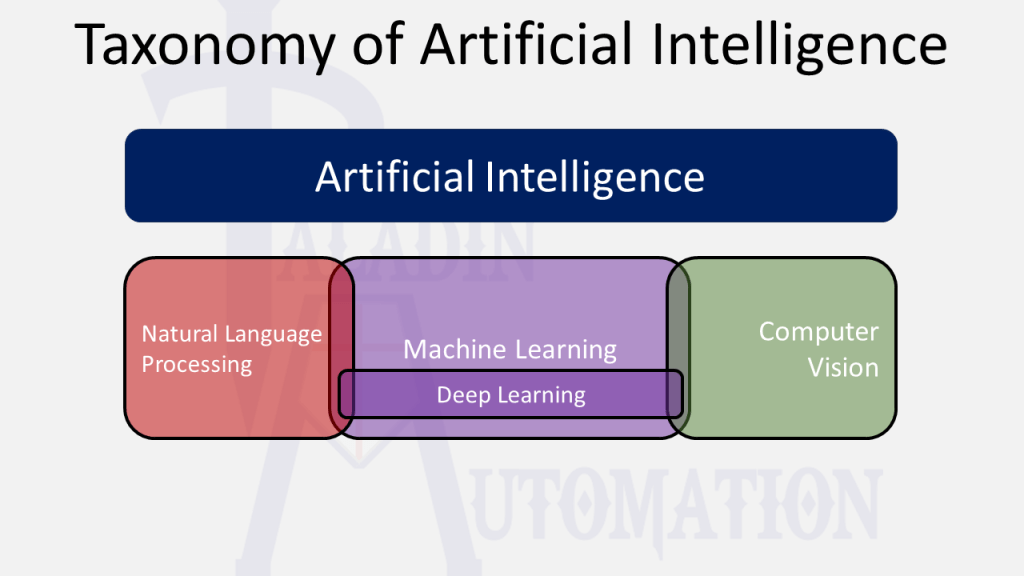
My goal is not to write a treatise on AI, and I welcome constructively-critical commentary about how I chose to organize the field.
Why do I link AI to Drones? A drone is essentially a flying computer and is part of a computing ecosystem that includes the ground controller and data processing system(s). AI augments the human-machine interface with the drone through pre-flight planning, in-flight control, and post-flight processing. The drone provides information that becomes AI training data. Drones and AI have a complementary relationship in the cyber-physical world.
DRONES Index
Most of Gartner’s cutting-edge technological development is being conducted in small start-up companies and academic institutions. But some of it is being conducted by publicly-traded companies in the U.S., and several of these are already listed in my DRONES Index.
Of the 37 companies in the DRONES Index, I will highlight those companies that specialize in development that aligns with the tenets of the 2023 Gartner Hype Cycle.
AVAV AeroVironment, Inc.
UAVS AgEagle Aerial Systems, Inc.
JOBY Joby Aviation, Inc.
KTOS Kratos Defense & Security Solutions
WKHS Workhorse Group, Inc.
LHX L3Harris Technologies, Inc.
AMBA Ambarella, Inc.
MRCY Mercury Systems Inc
TXT Textron Inc.
TRMB Trimble Inc.
HEI Heico Corporation
PLTR Palantir Technologies Inc.
VLDR Velodyne Lidar, Inc.
TDY Teledyne Technologies Incorpora
IIVI II-VI Incorporated
KAMN Kaman Corporation
GD General Dynamics Corporation
CMTL Comtech Telecommunications Corp
GPRO GoPro, Inc.
GFF Griffon Corporation
NOC Northrop Grumman Corporation
JBL Jabil Inc.
NVDA NVIDIA Corporation
UPS United Parcel Service, Inc.
FDX FedEx Corporation
BA Boeing Company (The)
LMT Lockheed Martin Corporation
HON Honeywell International Inc.
RTX Raytheon Technologies Corporation
INTC Intel Corporation
AMZN Amazon.com, Inc.
WMT Walmart Inc.
GOOGL Alphabet Inc.
VZ Verizon Communications Inc.
QCOM QUALCOMM Incorporated
T AT&T Inc.
GE General Electric Company
If you are looking for opportunities to invest in companies that are pioneering emerging technologies and also support the Drone Industry, this is a good starter list to add to your watchlist.
As always, conduct your own research and consult with a Financial Advisor prior to making any investment decisions.
One response to “GARTNER HYPE CYCLE (2023 UPDATE)”
-

[…] is a software development company specializing in artificial intelligence (AI). It is based in Salt Lake City, UT. The company announced partnership with Teal Drones in […]
LikeLike
 Paladin Automation LLC
Leave a comment